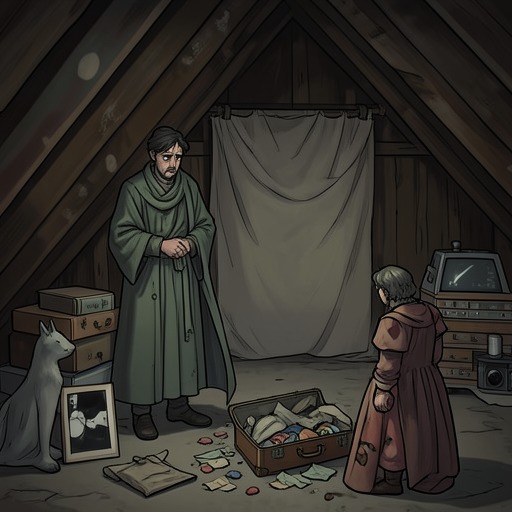
The broken suitcase
Beautiful Boy: A Father's Journey Through His Son's AddictionThe broken suitcase is David Sheff’s image for a mind whose contents have become inaccessible and disordered. First it gives physical form to his loss of memory and orientation during a brain crisis; later, the repaired lock marks his return toward ordinary life. In the book’s reflections on addiction and brain damage, the image also carries a more fragile implication: mental recovery is possible, but the brain can be gravely harmed.
The Image During the Brain Crisis
During the episode, David asks someone to tell his editor that his suitcase is broken and its locks do not work. The request sounds practical, but it is also an oblique description of his condition. He cannot remember his own name, where he is, or the editor’s telephone number. In his account, the mind becomes a suitcase filled with everything he is, its broken lock allowing the contents to spill out.
The spilled digits suggest not just a missing fact but the disintegration of the connections that make facts usable. David compares the disorder to an overturned bucket of Legos and to Nic’s collection of tiny seashells from China Beach. The shell memory itself falters: David cannot establish whether Nic was four when he collected them. Even a vivid image from his son’s childhood arrives with a gap in its chronology.
One thought remains intact amid that confusion: Nic is in danger. David says he cannot forget this, even with his brain awash with toxic blood. The contrast gives the image its emotional force. Names, locations, and numbers have escaped him, but his fear for his son persists.
Repair and Return
After the hospital stay and time recovering at home, David describes his head as mended and the suitcase lock as repaired. He had missed much of June and July, and his return to activity is tentative: he is ready, as much as he can be, to rejoin the living and tries to hold on to the last of summer. The repaired lock turns a physical object into a compact measure of change, linking the earlier breakdown in memory to a renewed, though not effortless, sense of wholeness.
That return takes place with Karen, Jasper, and Daisy on the Big Sur coast. The family hikes and plays on the beaches; at their campsite beside the river, Daisy calls the day beautiful. The scene does not erase the earlier crisis. Instead, its ordinary details—camping, time outdoors, children returning to school soon—show David stepping back into family life after a period when even basic orientation had failed him.
A Figure for Mental Vulnerability
The image gains a wider resonance in the book’s account of methamphetamine. David reflects that meth can make the brain misfire and that, before reaching a turning point, some people die while others are left paralyzed or brain-damaged after a stroke or a similar event. This is not presented as the cause of his own brain crisis; rather, it places the suitcase beside the book’s broader recognition that the brain can be injured and that the consequences may be devastating.
As an expression, the broken suitcase holds two states together: a mind whose contents have scattered and a mind that can, at least in David’s account of his recovery, be mended. Its image of a failed lock makes cognitive loss concrete without reducing it to forgetfulness alone. The scattered phone digits, the uncertain childhood memory, and the fear for Nic show different parts of a self under strain—and the return of the repaired lock offers a measure of recovery without implying that vulnerability has vanished.